Model | Filter Grade | CADR | Coverage | Price Tier |
|---|---|---|---|---|
Coway Airmega 150 | True HEPA H13 | ~240 m³/h | 355 sq ft | Premium |
Honeywell Air Touch V3 | True HEPA H13 | 300 m³/h | 465 sq ft | Budget |
Xiaomi Smart Air Purifier 4 | True HEPA H13 | 400 m³/h | up to 516 sq ft | Mid-range |
Philips AC0920 | HEPA NanoProtect* | 250 m³/h | up to 300 sq ft (personal) | Budget |
Qubo Q600 | True HEPA H13 | 450 m³/h | 600 sq ft | Mid-range |
Search "best true hepa filter air purifiers" and you'll find no shortage of round-up articles, most of them padded with generic advice and stock-photo-grade product blurbs. The actual problem buyers run into isn't a lack of options — it's that "HEPA" gets printed on boxes that don't meet the standard, and even genuine True HEPA units get compared on device price alone, when the real cost of owning one is spread across years of filter replacements nobody mentions upfront.
This guide sticks to units that are verifiably True HEPA H13 (we flag the one exception explicitly), matches them to realistic Indian room sizes, and — this is the part most buying guides skip — works out what each one actually costs to run for three years, not just what it costs to unbox.
The one thing to remember before you buy anything: insist on "True HEPA" or "H13" in the actual filter description, not just the box. "HEPA-type" and "HEPA-like" are marketing phrases for filters that fall well short of the standard — they'll still say "HEPA" somewhere on the packaging, which is exactly the confusion sellers rely on.
\Philips markets the AC0920's filter as "HEPA NanoProtect," its own branded 2-layer filtration, rather than an H13-certified True HEPA filter — see the note on its card below. Price tiers are relative to this list, not fixed brackets, and shift as marketplace pricing moves — check the current listing before buying.*
Coway Airmega 150 (AP-1019C)
Price Tier: Premium Best for: bedrooms and living rooms up to 355 sq ft, lowest long-run hassle
Coway's Green True HEPA H13 filter is rated to trap 99.999% of particles down to PM0.01 — well past the 99.95% baseline the H13 standard requires — and it's backed by a genuinely long 8,500-hour filter life, which works out to roughly 1.5–2 years of typical household use instead of the 6–12 months most purifiers demand. The one-touch cartridge swap means you're not scraping filter foam out by hand every time either.
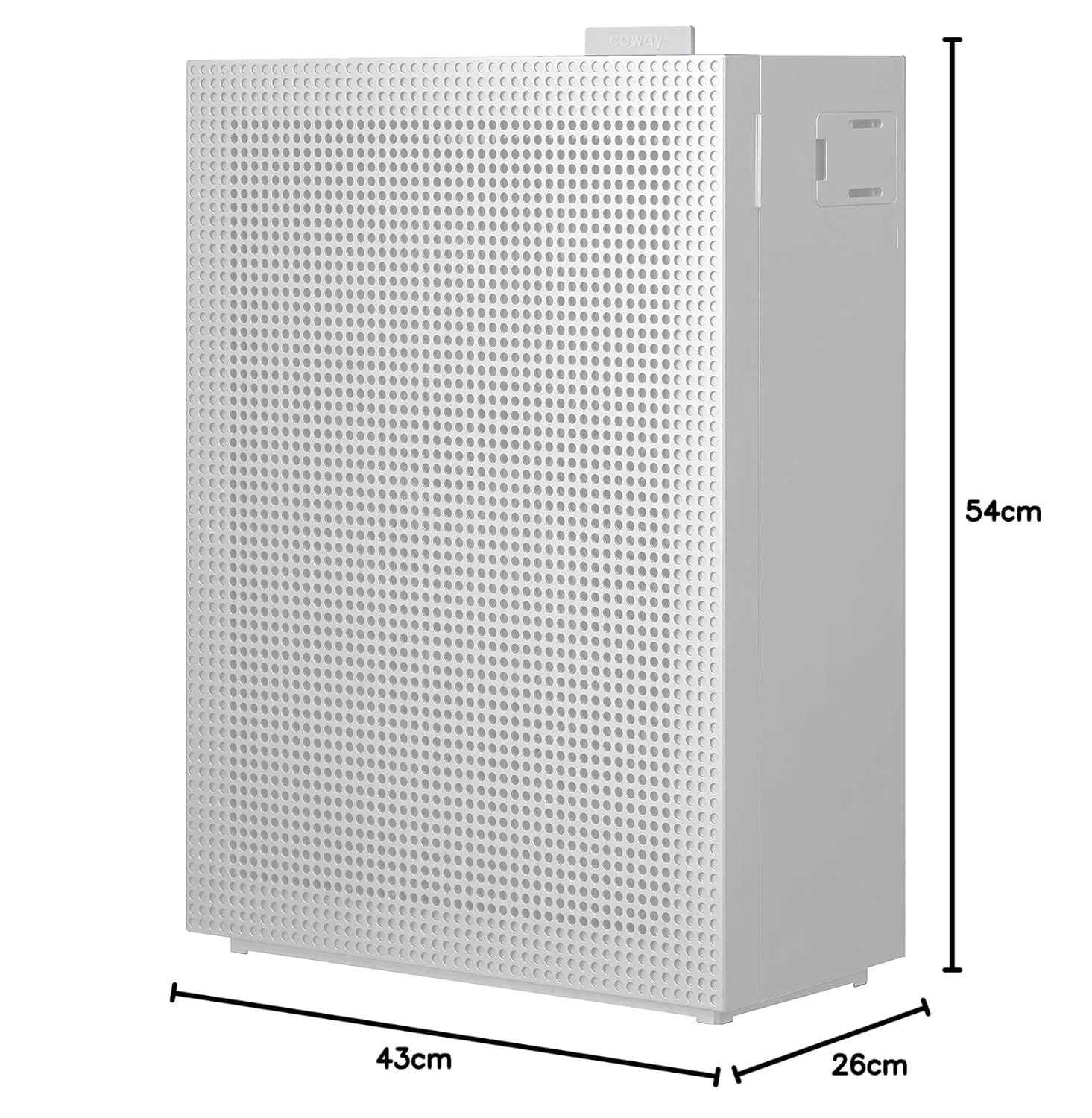
Noise runs from a near-silent 22 dB on low up to 49 dB on the highest fan speed, and Coway backs the motor with an unusually long 5-year warranty (1 year on electrical parts). The trade-off is a 355 sq ft coverage limit — this is a single-room unit, not a whole-apartment solution.
✓ Verdict: Buy It — Best Overall. The filter life alone changes the ownership math in its favour; see the cost table below.
Honeywell Air Touch V3
Price Tier: Budget Best for: larger single rooms on a tighter budget, 465 sq ft coverage

The Air Touch V3 runs a proper 3-stage setup — pre-filter, H13 HEPA, and activated carbon — rated to remove 99.99% of allergens and PM2.5. At a 300 m³/h CADR and 465 sq ft coverage, it comfortably out-covers the Coway above, which matters if you're purifying a larger living room rather than a bedroom.
It draws 65W at full tilt, has a child lock and filter-replacement indicator, and skips app connectivity entirely — everything is controlled from the unit itself, which is either a non-issue or a dealbreaker depending on whether you actually use purifier apps.
✓ Verdict: Buy It — Best Value True H13. The cheapest genuinely certified True HEPA H13 purifier on this list, and still covers a proper living room.
Xiaomi Smart Air Purifier 4
Price Tier: Mid-range Best for: the best CADR-per-rupee on a certified True HEPA H13 filter

Xiaomi's successor to the Mi Air Purifier 3 pushes the numbers up across the board — a 400 m³/h CADR and coverage up to 516 sq ft, ahead of both the Coway and Honeywell above, on a True HEPA H13-grade filter with an activated carbon layer for odour. The 360° cylindrical intake and a negative-ion stage for neutralising airborne dust and pollen carry over from the line's usual design.
The OLED display and Mi Home app add real-time AQI tracking and remote control via Alexa or Google Assistant. Filter life runs 6–12 months depending on air quality, on the shorter side of this list, and it's no longer the cheapest unit here — the Honeywell V3 above now undercuts it — but it buys the highest CADR and coverage of any purifier on this list that isn't the large-room Qubo.
✓ Verdict: Buy It — Best CADR for the Price. Pick this over the Honeywell V3 specifically if you need the extra coverage; otherwise the Honeywell is the cheaper True HEPA H13 option.
Philips AC0920
Price Tier: Budget Best for: a single small room or personal desk-side use

This is the one exception on the list, and it's worth being upfront about it: Philips markets the AC0920's filtration as "HEPA NanoProtect," its own 2-layer system rated to capture 99.97% of particles as small as 0.003 microns using an electrostatic charge — not an H13-certified True HEPA filter in the strict sense. In practice, independent test data on Philips's NanoProtect line has generally shown strong real-world performance, but if your search was specifically for H13-certified units, know what you're buying.
Where it does win: real-time AQI display, a genuinely quiet 20.5 dB sleep mode, and a compact footprint that suits a bedroom or study rather than a hall.
◐ Verdict: Worth Considering — Not H13-Certified. Buy this for the compact size and sleep-mode quietness, not because you searched for "True HEPA."
Qubo Q600 Smart Air Purifier
Price Tier: Mid-range Best for: large living rooms and open-plan spaces up to 600 sq ft

Qubo's Q600 is built for rooms the rest of this list can't cover — a 450 m³/h CADR pushing air across up to 600 sq ft, using a 5-stage setup (two pre-filters, nano-silver antibacterial coating, activated carbon, and True HEPA H13) rather than the usual 3-stage arrangement. App and voice control (Alexa/Google Assistant) is included, along with Auto, Manual, Sleep, and AI modes.
The catch shows up in the ownership numbers below: a 9,000-hour filter life sounds long, but at typical usage that's closer to a year, and the replacement filter itself isn't cheap — see the table for exactly how that plays out.
◐ Verdict: Worth Considering — Check the Filter Cost First. The right size and CADR for a large room, but read the 3-year cost table before deciding.
The Real Cost: 3-Year Ownership, Not Just the Sticker Price
This is the number every other "best true hepa filter air purifiers" guide leaves out. A cheaper purifier with a short filter life and an expensive replacement filter can easily cost more to run than a pricier unit with a long-lasting filter. Here's the device price tier plus estimated filter-replacement burden over three years of typical household use for each pick above.
Model | Device Price Tier | Filter Change Frequency (3 Yrs) | Est. 3-Yr Ownership Cost |
|---|---|---|---|
Coway Airmega 150 | Premium | 2 changes (8,500-hr life) | High |
Honeywell Air Touch V3 | Budget | 3 changes (~10-month life) | Low |
Xiaomi Smart Air Purifier 4 | Mid-range | 3 changes (6–12 month life) | Moderate |
Philips AC0920 | Budget | 3 changes (~12-month life) | Lowest |
Qubo Q600 | Mid-range | 3 changes (9,000-hr life) | Highest |
Ownership-cost tiers combine device price and estimated filter replacement cost over three years of typical household use, ranked relative to each other on this list — not fixed brackets. Filter life is manufacturer-stated; actual cost depends on usage hours, local air quality, and current filter listing prices, so confirm both before you commit to a brand.
The table reframes the list: the Philips AC0920 and Honeywell Air Touch V3 come out cheapest to actually own over three years, not just to unbox — though remember the Philips isn't H13-certified. The Qubo Q600, despite a mid-range device price, ends up the most expensive to own on this list, purely because its filter is both shorter-lived and more expensive to replace. If you're buying the Q600 for its large-room CADR, or the Xiaomi Smart Air Purifier 4 for its coverage over the Honeywell, budget for the higher filter cost going in rather than being surprised by it a year later.
How to Actually Choose One
What "True HEPA H13" means, and why it's worth insisting on
A True HEPA filter graded H13 or higher is certified to capture at least 99.95% of particles at 0.3 microns — the particle size that's hardest for any filter to trap, smaller particles and larger ones are both easier to catch. "HEPA-type," "HEPA-like," or "HEPA-style" on a listing means the filter has not been tested to this standard, and in practice these filters often capture meaningfully less. The word "HEPA" alone guarantees nothing; the grade and certification language does.
Match CADR to your room size, then compare price
Clean Air Delivery Rate (CADR) tells you how much filtered air the unit pushes out per hour. As a rough rule, look for a CADR in m³/h that's at least five times your room's floor area in square metres — a 15 m² bedroom wants at least 75 m³/h, more if you're in a high-pollution city. Buying a high-CADR unit for a small room wastes money; buying a low-CADR unit for a large hall means it never actually catches up with the pollution entering the room.
Filter replacement cost matters more than the box price
As the ownership table above shows, the running cost of a purifier is dictated almost entirely by how often you replace the filter and what that filter costs. Before buying, look up the specific replacement filter price and how long the manufacturer rates it for — not just the device's own listing, since sellers rarely surface this number next to the purifier itself.
HEPA only catches particles — carbon catches gas and odour
A HEPA filter, however good, does nothing for cooking smells, tobacco smoke odour, or volatile organic compounds (VOCs) — those need a separate activated carbon layer. If you live near a busy road or do a lot of frying at home, check that the unit you're buying has a real carbon stage, not just a thin carbon-coated pre-filter that's mostly there for marketing.
Noise and placement decide whether you'll actually use it
A purifier that's too loud on the setting you need ends up switched off or turned down below the speed required to clean the room — which defeats the purpose entirely. Check the dB rating on the fan speed you'll realistically run overnight, not just the lowest "sleep mode" number quoted on the box, and place the unit away from walls and furniture so air can circulate into it freely from all sides.
Buy one size up if you're in a high-pollution city
Manufacturer coverage figures assume sealed, ideal conditions that don't really exist in an Indian home with doors opening and closing all day. If you're in a city that regularly sees "poor" or "severe" AQI days, size up by one coverage tier from what the room technically needs — the extra CADR buys you a faster recovery time after a door's been open.
Frequently Asked Questions
What does "True HEPA" actually mean? True HEPA, usually graded H13 or higher, captures at least 99.95% of particles at 0.3 microns — the hardest size to trap. "HEPA-type" or "HEPA-like" filters are not held to this standard and typically capture far less.
Is a higher CADR always better? Only relative to your room size. A high-CADR purifier in a small room is wasted spend; a low-CADR unit in a large hall won't clean the air fast enough. Match CADR to square footage first, then compare price.
Is a higher CADR always better? Only relative to your room size. A high-CADR purifier in a small room is wasted spend; a low-CADR unit in a large hall won't clean the air fast enough. Match CADR to square footage first, then compare price.
Why do air purifiers with a similar price have very different running costs? The device price is a fraction of what you'll spend. Filter life and filter price vary hugely between brands, and a cheaper purifier with short-lived, expensive filters often costs more over three years than a pricier one with a long-life filter — see the ownership table above.
Why do air purifiers with a similar price have very different running costs? The device price is a fraction of what you'll spend. Filter life and filter price vary hugely between brands, and a cheaper purifier with short-lived, expensive filters often costs more over three years than a pricier one with a long-life filter — see the ownership table above.
Do air purifiers help with mosquitoes or smoke smell? A True HEPA filter traps smoke particles effectively, but odour and gases need an activated carbon layer alongside it. Mosquitoes are too large and mobile for a purifier to meaningfully control — that needs a separate repellent.
Do air purifiers help with mosquitoes or smoke smell? A True HEPA filter traps smoke particles effectively, but odour and gases need an activated carbon layer alongside it. Mosquitoes are too large and mobile for a purifier to meaningfully control — that needs a separate repellent.
Can one air purifier cover my whole house? No. Coverage ratings are per closed room, not whole homes with open doors and multiple rooms. Most households need one unit per bedroom or living area rather than a single purifier for everything.
Final Verdict
If you want the best true HEPA filter air purifier without thinking about filter costs again for two years, the Coway Airmega 150 is the pick — its 8,500-hour filter life carries it past the field on total ownership cost, even at a higher upfront price.
On the tightest budget for genuine True HEPA H13, the Honeywell Air Touch V3 is now the cheapest certified pick on this list and still covers 465 sq ft without a major cost penalty. If your room is bigger than that, the Xiaomi Smart Air Purifier 4 covers up to 516 sq ft on the same H13 grade, at a real but modest premium over the Honeywell.
Skip the Qubo Q600 unless you specifically need its 600 sq ft coverage — the CADR is genuinely excellent, but budget for its filter cost separately. And if you were drawn to the Philips AC0920 purely because it said "HEPA," it's a fine compact purifier, just not a True HEPA H13 one — decide with that clearly in mind rather than assuming otherwise.
How we researched this guide
These picks come from desk research, not hands-on testing. We compare published specifications against others in the same price band, read through verified buyer reviews for problems that repeat rather than one-off complaints, and check the current Amazon.in price to judge value. Products are scored on the same three factors every time — specifications (40%), buyer sentiment (40%) and value for money (20%).
We have not physically tested these products, and we say so rather than implying otherwise. Where a claim about safety, certification, battery behaviour or warranty appears in this guide, it comes from the manufacturer’s own documentation or the retailer’s listing — we do not verify manufacturer claims independently. Read the full methodology or tell us about a mistake via our corrections policy.