- Coway Airmega 150 (AP-1019C)
- Xiaomi Smart Air Purifier 4
- Philips AC1711
- Honeywell Air Touch V3
- Honeywell Air Touch V1
- Qubo Q200 Smart Air Purifier
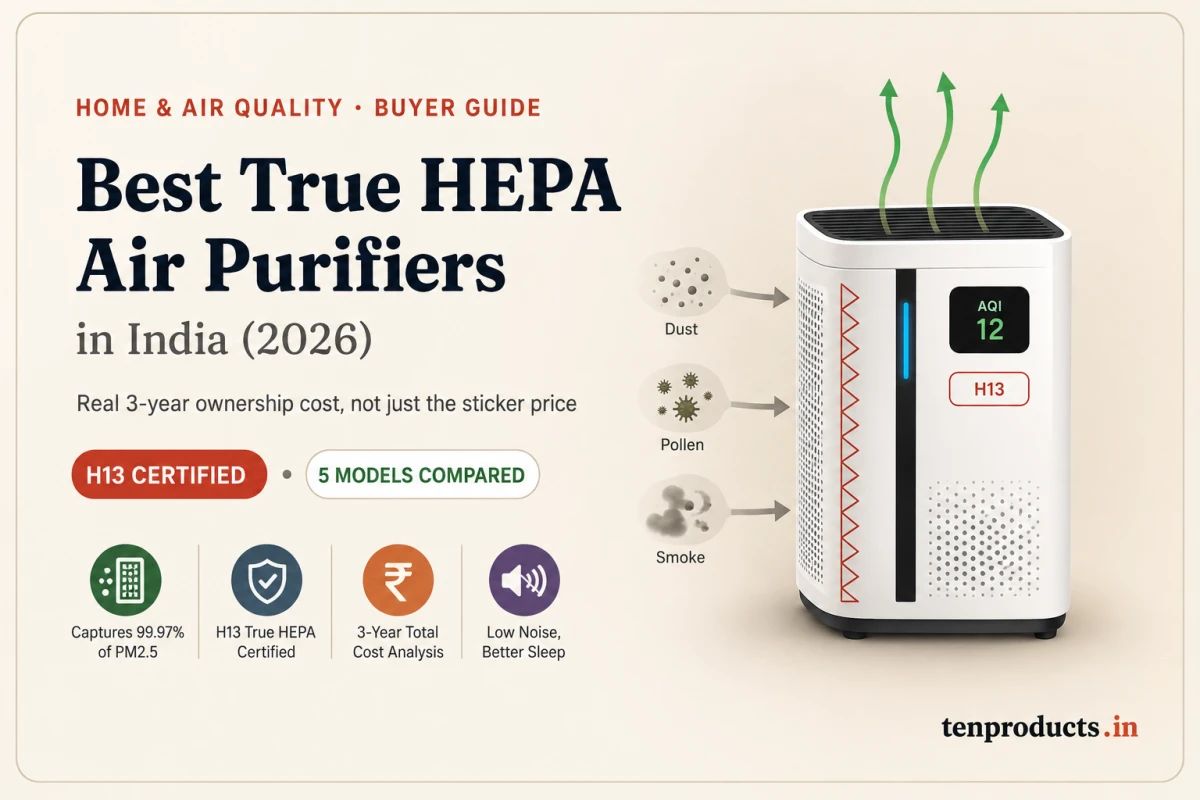
Most "best air purifier" roundups stop at the CADR number, which is a bit like judging a car only by its top speed. The number that actually decides whether you're happy with a purifier a year in is how often you're buying a new filter, and how much of a hassle that turns out to be. We went through what's currently sold on Amazon.in, checked what each unit genuinely covers and filters, and thought about what it's like to actually own one — not just unbox it.
Performance comparison
Numbers below are what each brand states on the listing. Take the coverage figures with a small pinch of salt — more on why in the buying guide.
| Model | HEPA Grade | CADR | Rated Coverage | Filter Life |
|---|---|---|---|---|
| Coway Airmega 150 | True HEPA H13 | 303 m³/h | ~355 sq ft | ~8,500 hrs (roughly 1.5-2 yrs) |
| Xiaomi Smart Air Purifier 4 | True HEPA | 400 m³/h | 516 sq ft | 6-12 months |
| Philips AC1711 | NanoProtect HEPA | 300 m³/h | 380 sq ft | ~9,000 hrs (about a year) |
| Honeywell Air Touch V3 | Dual H13 HEPA | Not published | 465 sq ft | 6-9 months |
| Honeywell Air Touch V1 | H13 HEPA | Not published | 235 sq ft | 6-8 months |
| Qubo Q200 | True HEPA H13 | 150 m³/h | 200 sq ft | ~9,000 hrs (about a year) |
What it costs to actually own one
Nobody budgets for filters when they're buying the machine, and then six or nine months later there's a small surprise expense they didn't see coming. So instead of a purchase price you'll have forgotten by the time you need to read this section again, here's how each one actually behaves once it's living in your house.
Rough tiers based on how often the filter needs changing and roughly how much power the fan pulls on auto mode.
| Model | Filter Cost Tier | Running Cost Tier | Why |
|---|---|---|---|
| Coway Airmega 150 | Medium-High per change | Low | Pricier filter, but you're only buying it once every year and a half or two |
| Xiaomi Smart Air Purifier 4 | Low | Medium | Cheap, widely available filters relative to what it moves |
| Philips AC1711 | Low | Low | Low-wattage design keeps the electricity side minimal |
| Honeywell Air Touch V3 | Low | Medium | Bigger fan for bigger coverage draws a touch more power |
| Honeywell Air Touch V1 | Low | Low | Smallest unit here, smallest running cost to match |
| Qubo Q200 | Low | Low | Efficient BLDC motor, doesn't need to work hard for a small room |
Line these up against each other and something interesting happens to the Coway. It looks like the "expensive" one to keep fed until you realise it's fed half as often as everything else on this list — over a few years, that gap narrows a lot more than the sticker suggests. The two Honeywells and the Qubo stay the cheapest to run day to day, but that's mostly because they're covering smaller rooms with smaller fans, not because they're doing anything cleverer than the bigger units.
Buying guide: what the specs are actually telling you
CADR is the number everyone anchors on, and it's a decent one, but only once you stop trusting it at face value. Brands test it in sealed chambers with nothing else in the room. Your actual living room has a sofa, a rug, a half-open door to the balcony — none of which the lab accounted for. Simplest fix: whatever coverage number is printed on the box, mentally take 30% off it. A purifier rated for 500 sq ft will handle a 350 sq ft room properly. Don't expect the full 500.
HEPA grade is where a lot of listings get quietly vague. True HEPA — H13 or above — catches at least 99.95% of particles down to 0.3 microns, which happens to be right in PM2.5 territory. Plenty of cheaper units just say "HEPA-type" or skip naming a grade entirely, and that almost always means H11, sitting around 95%. Doesn't sound like a big gap on paper. In practice it's the difference between air that's actually gotten cleaner and a fan that's just making you feel like it has.
The activated carbon layer bundled into most true HEPA units earns its keep on odours and light gases — cooking smoke, fresh paint, that kind of thing. It clogs up well before the HEPA layer does though, especially if your kitchen opens into the same room and you're tempering dal every evening. It's a helper, not a replacement for a working exhaust fan.
And on noise — check it against how you'll actually use the thing, not the number on the spec sheet. A purifier that's silent on its lowest setting but has to run flat out to cover a room your size isn't quiet in any way that matters. If it's going next to your bed, look at the noise level at the speed you'll realistically leave it running overnight, not the "as low as X dB" line measured on a setting nobody uses.
1. Coway Airmega 150 (AP-1019C)
Model: AP-1019C · South Korean brand, sold through authorised Indian sellers
HEPA Grade: True HEPA H13CADR: 303 m³/hCoverage: ~355 sq ft
Coway keeps turning up at the top of independent Indian buying guides, and having actually looked at the spec sheet, it's not hard to see why. Three stages do the work here — a pre-filter for the bigger stuff, a patented urethane carbon filter for smells and VOCs, and a layered anti-virus true HEPA filter that Coway says doesn't just trap captured viruses but actually kills them. Small thing, but the one-touch filter removal is genuinely nice if you've ever fought a filter cartridge out of a cheaper machine at 11pm.

What earns it the top spot on cost, though, is how rarely you touch it. An 8,500-hour filter life works out to somewhere around 18 to 24 months before you need a replacement, against six to nine months for a lot of the competition. That patience is worth more than it sounds.
Pros
- Real True HEPA H13, with an anti-virus claim behind it
- Filter lasts a lot longer than most of what's on this list
- One-touch filter removal, no fighting with the casing
- Simple 4-colour air quality light, easy to glance at
Cons
- 355 sq ft won't stretch across a large open-plan living room
- No app control here
- Filter costs more per change than most alternatives
Buy It
The strongest all-rounder for a bedroom or a mid-size living room, and probably the cheapest one to keep running over a few years.
2. Xiaomi Smart Air Purifier 4
Model: Xiaomi Smart Air Purifier 4 · TÜV Allergy Care certified
HEPA Grade: True HEPACADR: 400 m³/hCoverage: 516 sq ft
Xiaomi's whole argument here is pretty simple: nothing else moves this much air for this little money. Triple-layer filtration, a proper 360° intake, a live AQI readout instead of a vague colour light, and app control through Xiaomi Home rather than some throwaway proprietary app you'll uninstall in a month. There's a negative ion mode too, but treat that as a footnote — the CADR and the filter cost are why this one's on the list.

You feel the price somewhere, though, and here it's the build. Mostly plastic, noticeably louder than the Philips or the Coway once you push it to full speed, and the dust sensor wants an occasional cotton-bud clean or it starts reading air quality wrong.
Pros
- Best air-moved-for-the-money on this whole list
- Actual PM2.5 number on screen, not just a light
- Filters are cheap and easy to find
- Full voice and app control via Xiaomi Home
Cons
- Build quality feels exactly like the price point
- Gets loud at top speed compared to the Philips or Coway
- The 516 sq ft claim is optimistic — plan for closer to 350
Buy It
Right pick if you want real coverage for a living room without spending Coway or Philips money to get it.
3. Philips AC1711
Model: AC1711/63 · Part of Philips' Series 1000i
HEPA Grade: NanoProtect HEPACADR: 300 m³/hCoverage: 380 sq ft
This one's built for a very specific ask: put it in the bedroom and forget it's there. The NanoProtect filter pulls out 99.97% of pollen, allergens, dust and smoke, and the whole design leans toward low noise and low power rather than chasing a bigger number on the spec sheet. People who own it tend to mention their sleep improving, which honestly says as much about the noise floor as it does about the filtration itself.

It's not the one for a large or open-plan space — 380 sq ft rated coverage really means something closer to 260-270 once you apply the usual discount — but in the room it's meant for, there's not much to complain about.
Pros
- One of the genuinely quiet bedroom options here
- 27W power draw, barely moves the electricity needle
- Trusted NanoProtect filtration
- Small enough to sit on a nightstand or corner table
Cons
- Not meant for a large or open-plan room
- No numeric AQI reading, just a light indicator
- Availability on Amazon comes and goes — check before you commit
Buy It
Buy this one specifically for a bedroom, where quiet matters more than covering a huge floor area.
4. Honeywell Air Touch V3
Model: Air Touch V3 · 5-stage filtration
HEPA Grade: Dual H13 HEPACoverage: 465 sq ftStages: Pre-filter, dual HEPA, activated carbon
Honeywell skips publishing a CADR figure on this one, which makes it a bit annoying to line up against the others on paper. But 465 sq ft of rated coverage and a dual-HEPA setup make it the biggest room option here apart from the Xiaomi. Five stages in total — a high-efficiency pre-filter, two HEPA passes, and activated carbon — aimed at what Honeywell calls "99.99% pollutants and micro allergens." For a living room that sees regular dust and the occasional round of Diwali smoke drifting in from outside, that's the job it's built for.

Pros
- Biggest rated coverage here besides the Xiaomi
- Dual HEPA stage gives a genuine filtration margin
- Honeywell's service reach across Indian cities is solid
Cons
- No published CADR makes direct comparison harder
- Bigger fan means it runs a touch warmer on the electricity front
- No app control at this tier
Buy It
Go with this one if your living room is genuinely large — the Coway and Philips would be undersized for the space.
5. Honeywell Air Touch V1
Model: Air Touch V1 · 3-stage filtration
HEPA Grade: H13 HEPACoverage: 235 sq ftStages: Pre-filter, H13 HEPA, activated carbon
This is about as close as the budget end of the market gets to genuine H13 filtration instead of a vaguely worded "HEPA-type" claim, and honestly that's most of the pitch. A pre-filter, true HEPA, and activated carbon layer cover a single bedroom or study without fuss, and Honeywell's name carries more weight for after-sales support in smaller Indian towns than some of the newer smart-purifier brands do.

No frills here. No app, no numeric AQI readout. Just a purifier doing the one job it was built for, at a price that doesn't need talking up.
Pros
- Actual H13 HEPA at a genuinely low price
- Compact enough for a small bedroom or study
- Well-known brand, decent service network across India
- Cheapest to run of everything on this list
Cons
- 235 sq ft is a single-room number, nothing more
- No app, no numeric display
- Filter needs changing more often than the pricier picks here
Buy It
Right call for a single bedroom or study when money's tight, without dropping down to a fake-HEPA unit to save a bit more.
6. Qubo Q200 Smart Air Purifier
Model: Q200 · Hero Group (Indian brand)
HEPA Grade: True HEPA H13CADR: 150 m³/hCoverage: 200 sq ft
Qubo is Hero Group's smart-home line, and the Q200 is worth a look if you'd rather deal with an Indian brand's support desk than wait on a global company's regional service team. It's genuinely smart for what it costs — QSensAI reads live air quality and adjusts the fan on its own, and the app handles filter reordering without you having to hunt down whether some third-party filter actually fits.

The trade-off is scale. 200 sq ft is small-bedroom or study territory, and the 150 m³/h CADR reflects exactly that. It's not trying to go head to head with the Xiaomi or the Honeywell V3 on raw coverage, so it wouldn't be fair to judge it on that basis.
Pros
- Genuinely True HEPA H13, not a watered-down claim
- QSensAI adjusts fan speed to live conditions on its own
- Ordering a replacement filter through the app is painless
- Efficient motor, doesn't cost much to keep running
Cons
- 200 sq ft keeps it to a small room
- Newer name in this category than Coway or Philips
- Fewer long-term reviews floating around than the bigger brands here
Buy It
A solid smart pick for a small room, especially if supporting an Indian brand's supply chain matters to you.
Frequently Asked Questions
What's the difference between HEPA and "HEPA-type" filters?
True HEPA, graded H13 or higher, captures at least 99.95% of particles down to 0.3 microns. HEPA-type or H11-grade filters, common in cheaper units, only manage around 95%. For Indian pollution, H13 is really the floor worth accepting.
How do I work out the right CADR for my room?
Take whatever coverage number the box promises and knock about 30% off it in your head. Brands test in sealed, empty chambers, and your actual room has doors, furniture and airflow the lab didn't account for.
Is an air purifier expensive to run every month?
Not really. Most home units draw somewhere between 15 and 45 watts on auto mode, which is a rounding error next to what an AC or geyser pulls. Electricity is almost never the reason one purifier costs more to live with than another.
How often do I need to replace the filter?
nywhere from six months to two years depending on the model and how dusty your air actually is. This is the real ongoing cost of owning a purifier, not the electricity bill, so it's worth weighing filter frequency as heavily as the purchase price itself.
Can an air purifier replace an AC or a humidifier?
No. It filters particles out of the air that's already in the room. It doesn't cool it, heat it, or change how much moisture is in it. A few premium models bolt on a humidifier function, but that's a separate feature, not something a standard purifier does.
Does spending more always mean better performance?
Not automatically. Price often tracks brand name and app polish as much as actual filtration. A mid-range purifier with a genuine H13 filter and a CADR that matches your room will usually beat an overpriced one leaning on vague marketing language.
Will an air purifier deal with cooking smoke and smell?
The activated carbon layer helps, but it clogs up faster than the HEPA layer does, especially with daily Indian cooking. Treat it as a helper, not a replacement for your kitchen chimney or exhaust fan.
Is app or Wi-Fi control worth caring about?
It's a nice convenience, being able to check air quality from your phone or set a schedule, but it shouldn't outrank CADR, HEPA grade or filter frequency. Use it to break a tie, not to make the decision.
Final word
Buying just one purifier for a bedroom or mid-size living room? Go with the Coway — it earns the reputation it has, and ends up the cheapest to live with over a few years despite the pricier filter. Want more coverage without spending that much, and you don't mind a plastic shell? The Xiaomi does that job well. Everything else here fits a specific room or a specific budget rather than being a compromise — match the coverage number to your actual space, knock 30% off whatever the box says, and the rest of this decision mostly makes itself.
How we researched this guide
These picks come from desk research, not hands-on testing. We compare published specifications against others in the same price band, read through verified buyer reviews for problems that repeat rather than one-off complaints, and check the current Amazon.in price to judge value. Products are scored on the same three factors every time — specifications (40%), buyer sentiment (40%) and value for money (20%).
We have not physically tested these products, and we say so rather than implying otherwise. Where a claim about safety, certification, battery behaviour or warranty appears in this guide, it comes from the manufacturer’s own documentation or the retailer’s listing — we do not verify manufacturer claims independently. Read the full methodology or tell us about a mistake via our corrections policy.