
- Best building set for age 5: LEGO Classic Creative Food Friends (11039) — 150 LEGO pieces with a step-by-step guide, then endless free building; rated 4.7 stars.
- Best magnetic tiles: GELTILES Magnetic Tiles (32 Pieces) — 32 Indian-made tiles with magnets strong enough for tall builds, according to owners.
- Best first science kit: Smartivity Magic Science Kit (Ages 4-8) — Colour-changing, fizzing and invisible-ink experiments designed for ages 4-8.
- Best logic puzzle: Magnalogix Magnetic Tangram Puzzle (Ages 5-7) — A magnetic tangram with 67 challenges, made specifically for ages 5-7 and good for travel.
- Best engineering kit for age 6+: Smartivity DIY Rocket Launcher STEM Kit — Build a wooden launcher and rocket, then learn about force and motion by firing it.
- Best for 7-year-olds: LEGO Creator 3 in 1 Turtle with Water Lily (31377) — A 3-in-1 LEGO Creator set with posable animals, rated 4.8 stars.
Search for STEM toys on Amazon.in and most of the best-sellers are labelled for ages 7 to 14 or 8 to 14. Give one of those to a five-year-old and a parent ends up building it while the child watches. The toys that work at five to seven are simpler: they let the child do the thinking and the building themselves, with results in minutes rather than hours.
For this guide we went through 578 STEM and educational toy listings on Amazon.in under ₹1500, kept toys whose stated age range genuinely includes 5 to 7 year olds, and read Amazon's review summaries for engagement, difficulty and missing-parts complaints. We chose one toy per kind of learning, so you can match the pick to the child. Every pick was in stock on 24 September 2026 and none carries Amazon's Frequently Returned Item warning.
One principle guided the list: a STEM toy only teaches if the child keeps coming back to it. Open-ended toys such as bricks and magnetic tiles usually outlast one-time kits, and the ranking reflects that.
The honest take
For most five-year-olds, the best STEM toy is a box of bricks or magnetic tiles, not a kit with 'STEM' in the title. Open-ended building teaches spatial reasoning, planning and cause and effect, and a child comes back to it for years. Science kits and DIY launchers are brilliant for a weekend with a parent but are usually finished within days. Buy one open-ended toy first, and add a kit as a treat.
How to choose
Trust the age range on the box, then check reviews
Manufacturers' age ranges are a minimum, not a target. A kit labelled 6-14 will suit a capable six-year-old with help, but a 7-14 or 8-14 kit usually needs an adult to do most of the work for a five-year-old. We also check whether owners agree: one popular 7+ construction set in this category is described in its own review summary as best suited to children 10 and older.
Match the toy to how the child learns
Children who love making things suit bricks and tiles. Curious question-askers enjoy science kits. Quiet, focused children often love logic puzzles such as tangrams. Children who like action and noise enjoy launchers. Choosing by the child's personality matters more than choosing by the 'S', 'T', 'E' or 'M'.
Open-ended beats one-time
A science kit with 20 experiments is done after 20 sessions. LEGO bricks and magnetic tiles can be rebuilt into something new every day for years. If you are buying one STEM toy, choose an open-ended one; if you are buying a gift for a child who already has bricks, a kit adds variety.
Check what is actually included
Science kits often advertise '50+ experiments' but include materials for fewer, with the rest needing household items. One owner of the Smartivity Magic Science Kit reports materials for about 20 experiments, with the rest explained in a booklet. Read the critical reviews for missing parts before buying a kit as a birthday gift.
Think about younger siblings
Small bricks, magnets and tiny screws are fine for a seven-year-old but not for a toddler in the same house. If there is a child under three at home, choose larger pieces and store small-part kits out of reach.
STEM toys for ages 5-7 compared
Ages and ratings are from each Amazon.in listing on 24 September 2026. 'Parent help needed' is our assessment based on the listing and owner reviews.
| Toy | Stated age | What it teaches | Replay value | Parent help needed | Rating |
|---|---|---|---|---|---|
| LEGO Classic Creative Food Friends 11039 | 4+ | Spatial reasoning, following instructions, design | High: open-ended | Low | 4.7 (900+) |
| GELTILES Magnetic Tiles (32 pcs) | 3+ | Geometry, 3D shapes, structures | High: open-ended | Low | 4.6 (600+) |
| Smartivity Magic Science Kit | 4-8 | Basic chemistry and physics through experiments | Medium: fixed experiments | Medium | 4.3 (790+) |
| Magnalogix Magnetic Tangram | 5-7 | Shapes, spatial reasoning, problem solving | Medium: 67 challenges | Low | 4.3 (1,600+) |
| Smartivity DIY Rocket Launcher | 6+ | Force, motion, simple engineering | Medium: build once, launch often | Medium to high | 4.3 (1,000+) |
| LEGO Creator 3 in 1 Turtle 31377 | 7+ | Complex building, rebuilding three models | High: three builds plus free play | Low for a 7-year-old | 4.8 (640+) |
Ages and ratings are from each Amazon.in listing on 24 September 2026. 'Parent help needed' is our assessment based on the listing and owner reviews.
Which one should you buy?
If this is you | Buy this |
|---|---|
The child is five and has never had a building toy | LEGO Classic Creative Food Friends (11039) |
The child builds towers from anything they can find | GELTILES Magnetic Tiles (32 Pieces) |
The child asks 'why?' about everything | Smartivity Magic Science Kit (Ages 4-8) |
You want a screen-free toy for car trips and restaurants | Magnalogix Magnetic Tangram Puzzle (Ages 5-7) |
The child is six or seven and loves things that move | Smartivity DIY Rocket Launcher STEM Kit |
The child is seven and already confident with LEGO | LEGO Creator 3 in 1 Turtle with Water Lily (31377) |
LEGO Classic Creative Food Friends (11039)
The verdict
The best all-round STEM toy for a five-year-old: quick early wins, then years of free building.
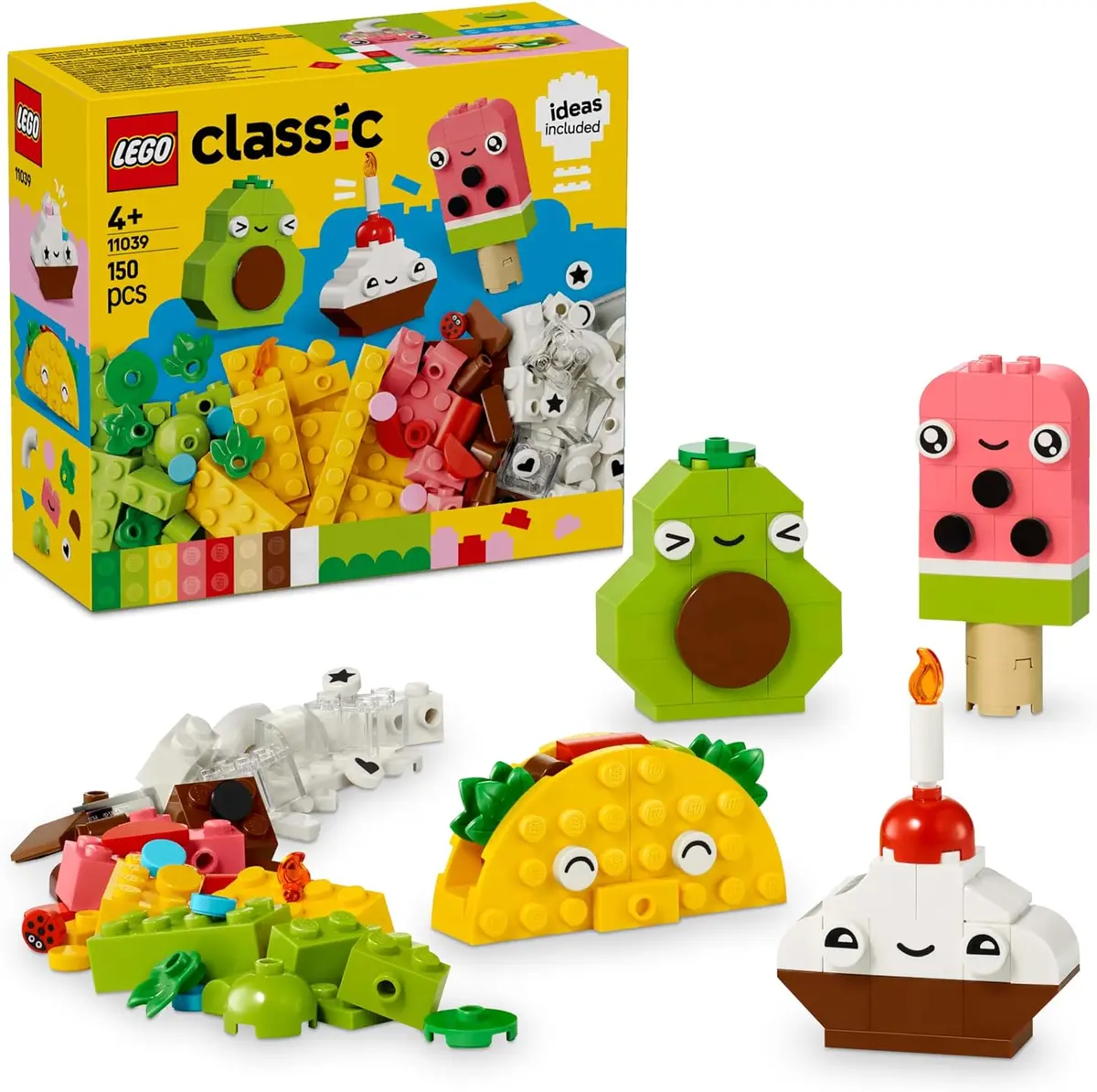
This LEGO Classic set is designed for ages 4 and up and contains 150 pieces, including eyes, mouths and decorative elements. The step-by-step guide shows how to build a cupcake, ice cream, avocado and taco, then rebuild them into a cake, bubble-tea drink, pear and panini, before the child moves on to free building. It has a 4.7-star average from more than 900 ratings.
Amazon's review summary says customers find it a great starter kit for young children, with bright colours and cute characters that inspire creativity, and appreciate how easy it is to build and play with. One reviewer notes how fun it is to create different food designs, and another says it keeps children engaged.
The limitation is size. At 150 pieces, a keen builder will want more bricks within months. The upside is that every LEGO set adds to the same collection, so it grows with the child.
Age | 4 years and up |
|---|---|
Pieces | 150 |
Models in guide | 8 food characters, then free building |
Skills | Spatial reasoning, following instructions, creativity |
Pros
- Designed for age 4+, so a five-year-old can build alone
- Quick models give early confidence
- Open-ended bricks work with any future LEGO set
- Rated 4.7 stars by more than 900 buyers
Cons
- At 150 pieces, a keen builder will want more
- Small pieces are not suitable for toddlers in the home
- Food theme may not appeal to every child
Best for: Five-year-olds starting out with building toys.
Skip it if: Children who already have a large LEGO collection.
Check today's price on Amazon →
GELTILES Magnetic Tiles (32 Pieces)
The verdict
The magnetic tiles to buy if you want tall, stable builds without frustration.
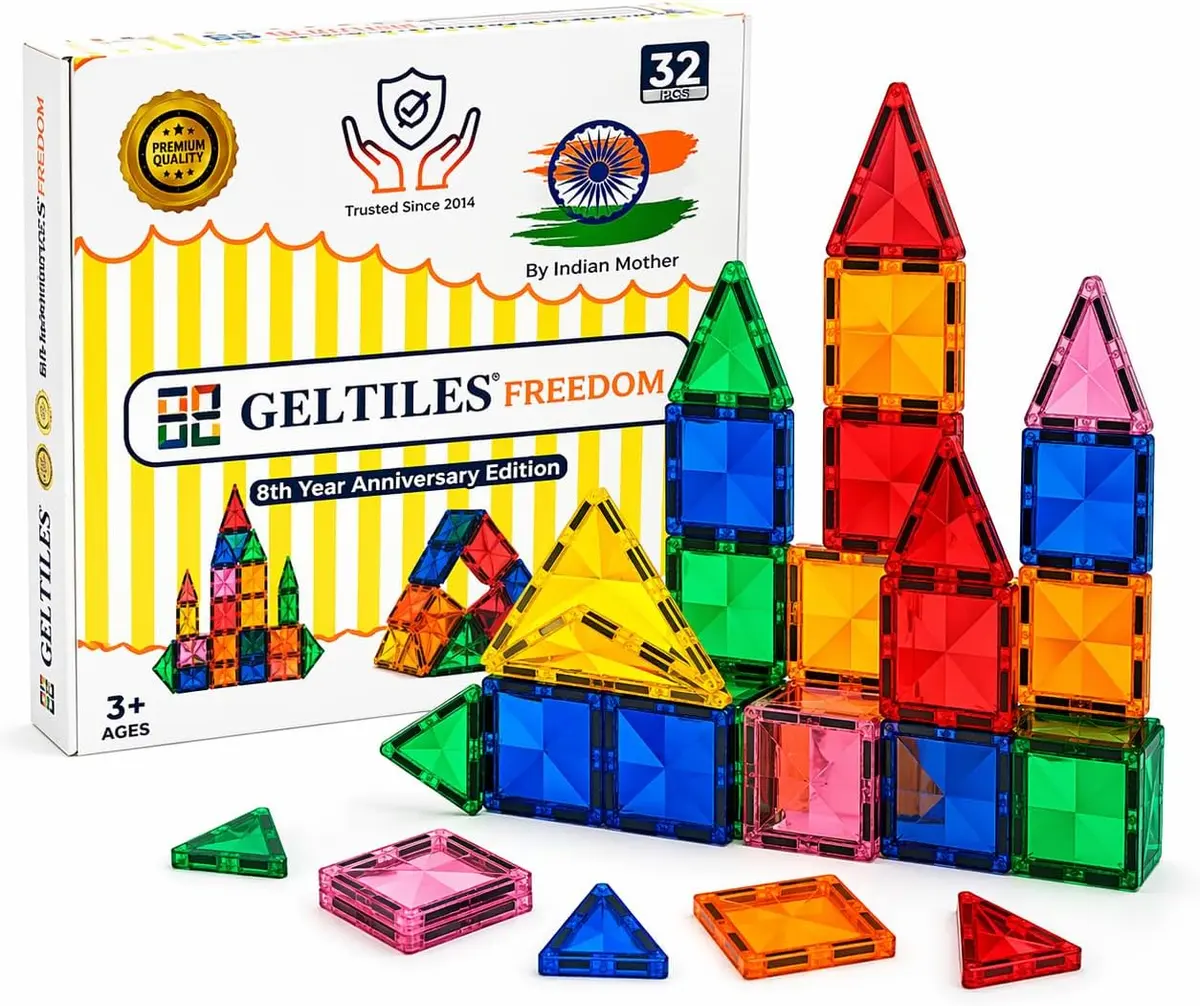
GELTILES is an Indian brand, and its listing says it has been making tiles since 2014. This 32-piece set uses ABS plastic with smooth edges and magnets strong enough, the brand says, that towers do not collapse. There are no instructions by design: children build castles, cars, rockets and anything else they imagine. It has a 4.6-star average from more than 600 ratings.
Amazon's review summary says customers find the tiles engaging and good for cognitive activities, durable enough that children can build taller structures without them collapsing, with good magnetic strength and colourful design. The set comes with an organised storage box.
Some owners find it expensive for 32 pieces, and it sits at the top of this guide's budget. Cheaper tiles exist, but magnet strength is where they cut corners: a popular 16-piece set we left out draws complaints that structures fall apart immediately.
Age | 3 years and up |
|---|---|
Pieces | 32 magnetic tiles |
Material | ABS plastic, smooth edges (brand claim) |
Made in | India (listing) |
Storage | Storage box included, per owners |
Pros
- Strong magnets for tall, stable builds, per owners
- Open-ended play with no instructions needed
- Durable tiles and a storage box
- Made in India
Cons
- Some owners find it expensive
- Top of this guide's budget
- 32 pieces limits very large builds
Best for: Children who love building and need quick, satisfying results.
Skip it if: Anyone with a toddler who puts things in their mouth; supervise magnet toys around small children.
Check today's price on Amazon →
Smartivity Magic Science Kit (Ages 4-8)
The verdict
A great first taste of science for curious five and six-year-olds, with a parent alongside.

Smartivity's Magic Science Kit is one of the few science kits actually designed for ages 4-8. The listing describes more than 50 activities, including colour-changing reactions, fizzing bubbles, rockets, invisible ink and mirror experiments, with easy-to-follow instructions and colourful illustrations. It has a 4.3-star average from nearly 800 ratings and more than 1,000 bought in the past month.
Amazon's review summary says customers find it fun and engaging, with clear instructions and easy experiments, ideal for young minds, and one says it enhances curiosity.
Be clear about what is in the box. One owner says materials for about 20 experiments are included, with the rest explained in a booklet and needing items you arrange yourself. The review summary also mentions missing parts and some experiments that do not work well. Open it before gifting.
Age | 4-8 years |
|---|---|
Activities | 50+ described (materials for some, per owners) |
Topics | Colour changes, fizzing reactions, invisible ink, mirrors |
Skills | Observation, cause and effect, early chemistry |
Pros
- Genuinely designed for ages 4-8
- Visible, exciting results children remember
- Clear, illustrated instructions
- More than 1,000 bought in the past month
Cons
- Not all 50+ experiments come with materials, per an owner
- Reports of missing parts
- Consumable, so replay value is limited
Best for: Curious five and six-year-olds and parents who enjoy doing experiments together.
Skip it if: Anyone wanting a toy the child can use alone for months.
Check today's price on Amazon →
Magnalogix Magnetic Tangram Puzzle (Ages 5-7)
The verdict
The best low-cost brain-builder here, made specifically for ages 5-7.
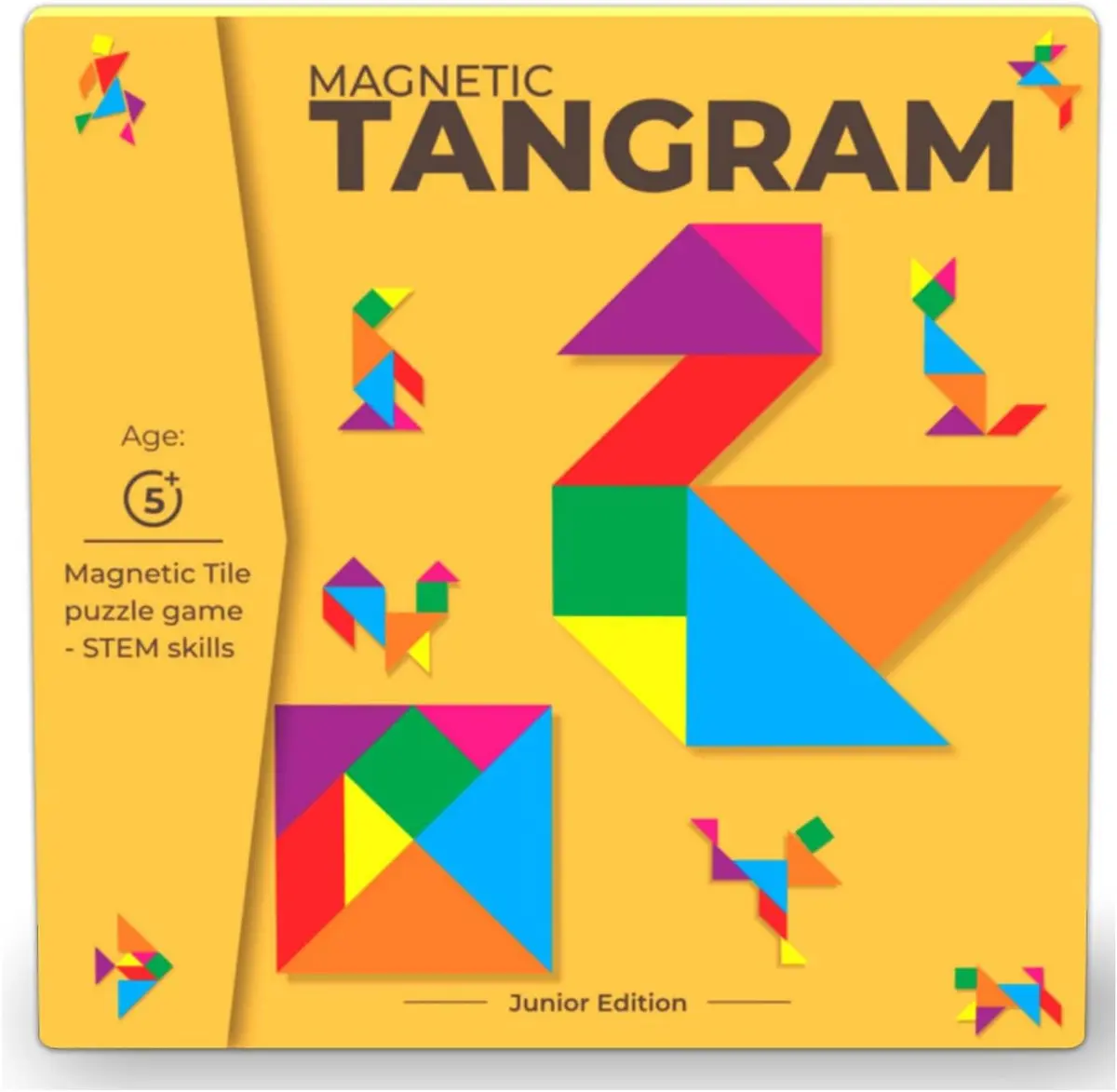
This is the only toy in the guide whose stated age range is exactly 5 to 7. It is a magnetic tangram: seven foam shape pieces with a rubberised magnetic backing on an 8 × 8 inch board, with 67 challenges in the puzzle book and a solution booklet. Tangrams are a classic way to build shape recognition and spatial reasoning. It has more than 1,600 ratings at 4.3 stars.
Amazon's review summary calls it a fantastic educational tool that encourages creativity and logical problem solving, and very engaging for young children. Because the pieces stay on the board, it works in the car, on a flight or at a restaurant table.
The review summary notes mixed feedback on magnet strength and durability, and several owners wish the pieces were bigger. With only seven foam pieces, some feel it is overpriced for what is in the box.
Age | 5-7 years |
|---|---|
Pieces | 7 magnetic foam shapes |
Challenges | 67 in the puzzle book |
Format | 8 × 8 inch travel book |
Pros
- Designed for exactly this age group
- Builds shape recognition and spatial reasoning
- Travel-friendly and screen-free
- The lowest-priced pick here
Cons
- Foam pieces and magnets draw some durability complaints
- Some owners want bigger pieces
- Only seven pieces in the box
Best for: Quiet, focused children, long journeys and return gifts.
Skip it if: Children who want to build big, physical structures.
Check today's price on Amazon →
Smartivity DIY Rocket Launcher STEM Kit
The verdict
A memorable build-and-launch project for a six or seven-year-old, best done with a parent.
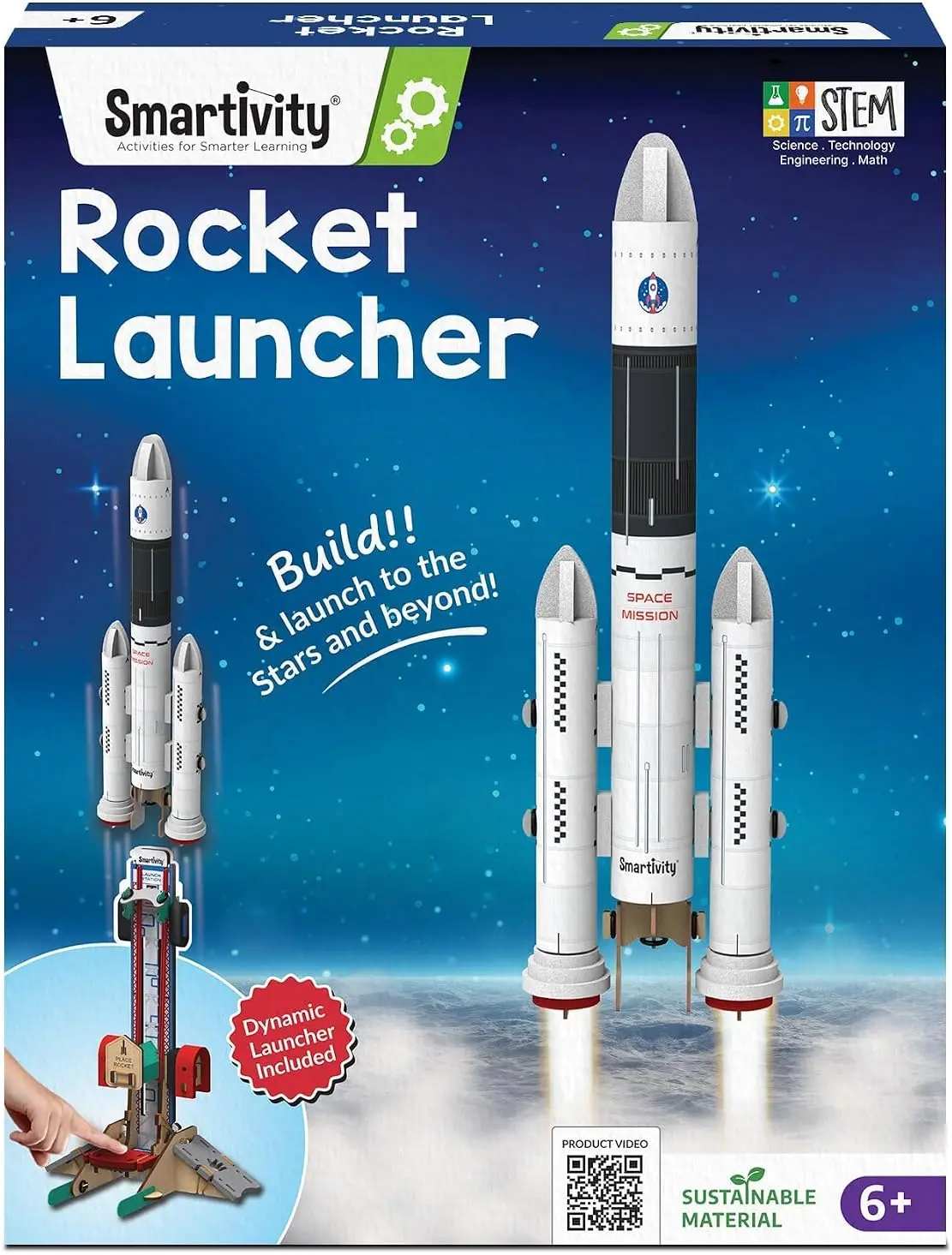
The Rocket Launcher is Smartivity's DIY kit for ages 6-12: children assemble a launcher and a rocket from engineered wood, then press the launch button and watch it fly. The listing says it introduces thrust, force, motion and aerodynamics. It has more than 1,000 ratings at 4.3 stars and over 2,000 bought in the past month.
Amazon's review summary says customers find it engaging and perfect for curious children, with clear instructions and real educational value for basic physics and engineering, and consider it a great gift.
Launch performance is mixed: the review summary reports some owners saying it works well and others that it does not work at all. One reviewer feels it is overpriced for short-term entertainment. For a six-year-old, expect to help with assembly.
Age | 6-12 years |
|---|---|
Material | Engineered wood (listing) |
Concepts | Thrust, force, motion, aerodynamics |
Skills | Following instructions, fine motor skills |
Pros
- A satisfying build with an exciting payoff
- Makes force and motion tangible
- Wooden parts, not flimsy plastic
- More than 2,000 bought in the past month
Cons
- Some owners report the launch does not work
- Needs adult help for younger children
- Limited replay once built
Best for: Six and seven-year-olds who love action, with a parent for the build.
Skip it if: Five-year-olds, who will find the assembly frustrating.
Check today's price on Amazon →
LEGO Creator 3 in 1 Turtle with Water Lily (31377)
The verdict
The next step up for a seven-year-old who has outgrown simple builds.
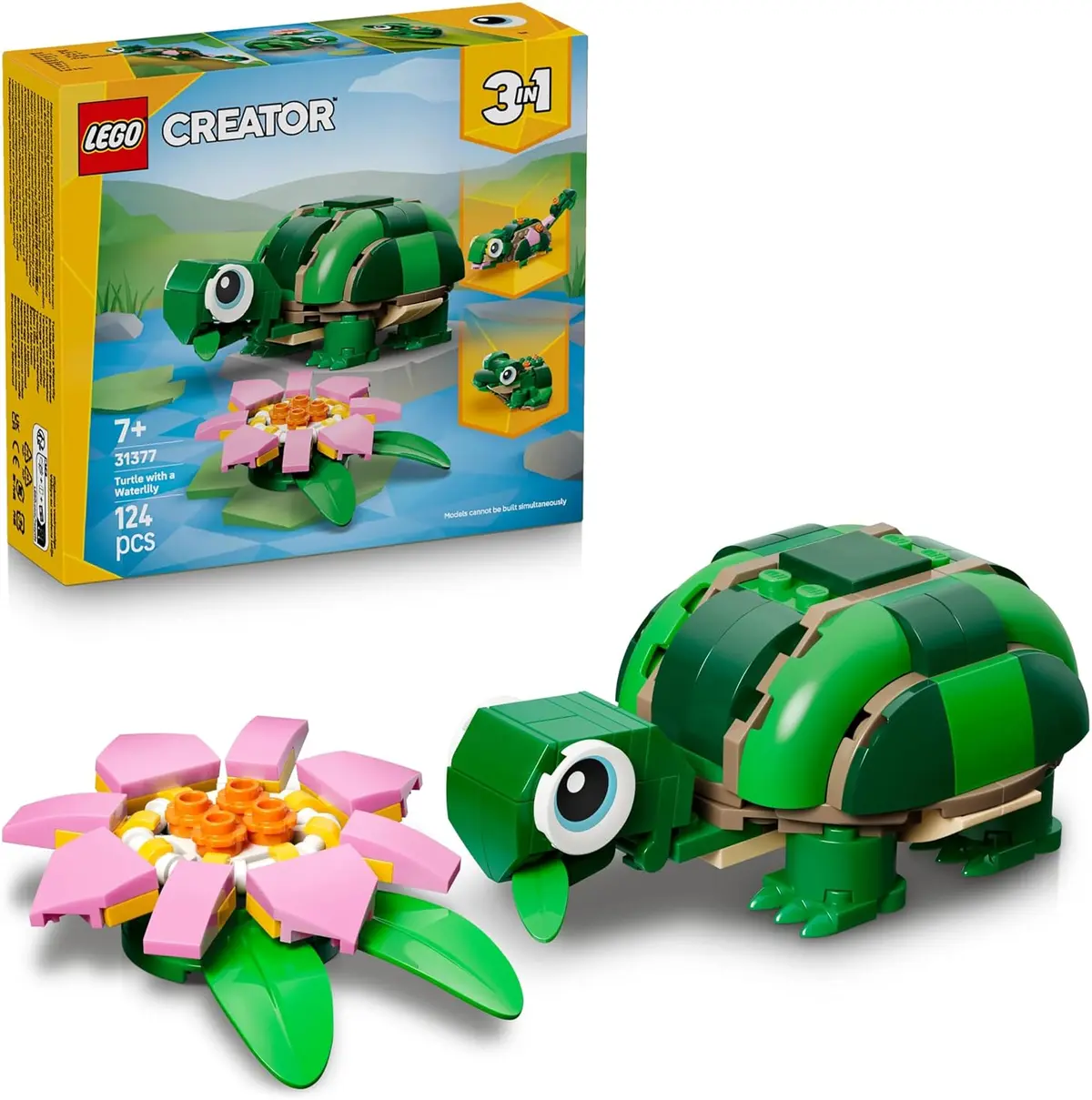
LEGO's Creator 3 in 1 sets let a child build three different models from the same bricks. This one, for ages 7 and up, has 124 pieces and builds a turtle with a water lily, a chameleon or a frog. The listing says the turtle has a posable head and mouth, the chameleon can nod and twist its tail, and the frog can open its mouth. It has the highest rating in this guide at 4.8 stars from more than 640 ratings.
Amazon's review summary says customers find it engaging, with one enjoying building all three versions, and consider it good value and a lovely present.
It is labelled 7+, so it is too advanced for most five-year-olds, and only one model can be built at a time. For a confident seven-year-old, though, rebuilding the same bricks into three animals is exactly the kind of problem-solving STEM toys are meant to teach.
Age | 7 years and up |
|---|---|
Pieces | 124 |
Models | Turtle, chameleon or frog |
Skills | Complex building, planning, rebuilding |
Pros
- Highest rating here at 4.8 stars
- Three models from one set
- Posable animals add play value
- Works with any other LEGO bricks
Cons
- Too advanced for most five-year-olds
- Only one model at a time
- A smaller review base than LEGO's older sets
Best for: Seven-year-olds who already enjoy LEGO.
Skip it if: Five and six-year-olds new to building sets.
Check today's price on Amazon →
Mistakes to avoid
Buying a 7-14 or 8-14 kit for a five-year-old
Many best-selling STEM kits are labelled for older children. The Mechanix Monster Buggies set, for example, is listed as 7+ on the product page, while its own listing details state ages 8 to 99, and its review summary says it is particularly suitable for children 10 and older, with many tiny pieces.
Choosing magnetic tiles on price alone
Weak magnets make structures collapse, which frustrates young children. A cheaper 16-piece set in this category draws complaints that its magnetic strength is too poor to hold shapes.
Trusting the experiment count on science kits
'50+ experiments' can include activities that need household materials. Check critical reviews for how many experiments the box actually supports.
Before you buy
If you are buying a gift, open the box and check the parts before wrapping it. Missing-parts complaints appear on several kits, and a gift with missing pieces is a disappointing surprise.
Keep small-part toys such as LEGO and science kits away from toddlers in the same home, and supervise magnetic toys around young children.
For long-term value, add to one open-ended system. A second LEGO set or more magnetic tiles multiplies what a child can build, while a second kit gives a few more afternoons.
Popular STEM toys we left out, and why
These rank highly in Amazon.in results for STEM and educational toys. Each was left out for a specific reason from its listing or Amazon's review summary on 24 September 2026.
Toy | Why it is not on the list |
|---|---|
Mechanix Monster Buggies | The product page says 7+, but its listing details state ages 8 to 99, and the review summary says it suits children 10 and older, with many very tiny pieces. |
Einstein Box Ultimate Science Kit | Very popular, but labelled for ages 7-14, so too advanced for most five and six-year-olds. |
Wembley Magnetic Tiles (16 pcs) | Cheaper than GELTILES, but reviewers complain of weak magnets, too few pieces and dull colours. |
Umadiya Take Apart Dinosaurs | Fun for younger children, but the review summary mentions missing parts and screws. |
Smartivity My First Science Experiment Kit | Good value, but owners note it includes only 18 experiments, and its title targets ages 6-14. |
Smartivity Robotic Mechanical Hand and Pinball Machine | Excellent kits, but labelled for ages 8-14. |
How we picked: We read 578 Amazon.in listings for STEM and educational toys, kept toys under ₹1500 whose stated age range includes 5 to 7 year olds with at least a 4.3-star average, removed anything out of stock, flagged as frequently returned or with repeated missing-parts complaints, then chose the best-reviewed toy for each kind of learning. We did not test these toys with children.
Frequently Asked Questions
What is the best STEM toy for a 5-year-old in India?
n open-ended building toy is usually best. The LEGO Classic Creative Food Friends set (ages 4+) and GELTILES magnetic tiles (ages 3+) both let a five-year-old build independently and keep playing for years.
Are STEM kits worth it for 5 to 7 year olds?
Yes, when the age range fits. Kits designed for ages 4-8, such as the Smartivity Magic Science Kit, work well with a parent. Kits labelled 8-14 usually need an adult to do most of the work.
What does a 6-year-old learn from magnetic tiles?
Magnetic tiles teach 2D and 3D shapes, balance, symmetry and simple engineering: children learn by trial and error which structures stand and which fall.
Which STEM toy is good for car trips?
The Magnalogix magnetic tangram, designed for ages 5-7, keeps its pieces on a magnetic board, making it practical in cars, trains and restaurants.
Is LEGO a STEM toy?
Yes. Building with LEGO develops spatial reasoning, planning, following instructions and design thinking, all core STEM skills. Sets with a 4+ or 5+ age rating suit five-year-olds best.
What STEM toy suits a 7-year-old?
t seven, children can handle more complex builds. The LEGO Creator 3 in 1 Turtle (7+) and the Smartivity DIY Rocket Launcher (6+) are good choices in this guide.
The verdict
For most five to seven-year-olds, start with an open-ended building toy: the LEGO Classic Creative Food Friends set for five-year-olds, or GELTILES magnetic tiles for children who love to build tall. They teach spatial thinking every day and never run out of experiments.
Add the Smartivity Magic Science Kit for a curious child, the Magnalogix tangram for travel and focus, or the Smartivity Rocket Launcher for a six or seven-year-old who loves action. For a confident seven-year-old builder, the LEGO Creator 3 in 1 Turtle is the best step up.
How we researched this guide
These picks come from desk research, not hands-on testing. We compare published specifications against others in the same price band, read through verified buyer reviews for problems that repeat rather than one-off complaints, and check the current Amazon.in price to judge value. Products are scored on the same three factors every time — specifications (40%), buyer sentiment (40%) and value for money (20%).
We have not physically tested these products, and we say so rather than implying otherwise. Where a claim about safety, certification, battery behaviour or warranty appears in this guide, it comes from the manufacturer’s own documentation or the retailer’s listing — we do not verify manufacturer claims independently. Read the full methodology or tell us about a mistake via our corrections policy.
